
Stephen King: "stories are found things,
like fossils in the ground"
Blazing Reader,
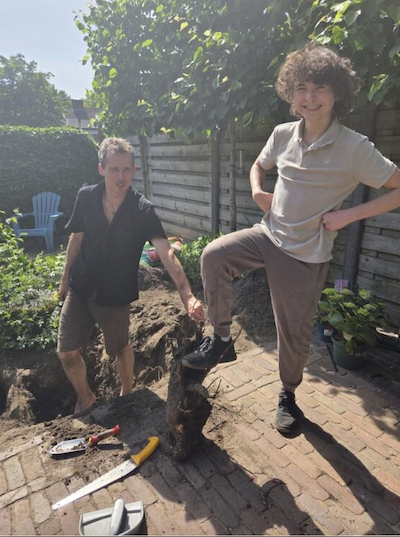
Here's a photo of my step-son, Kevin, and me, after excavating a large tree root from our garden:
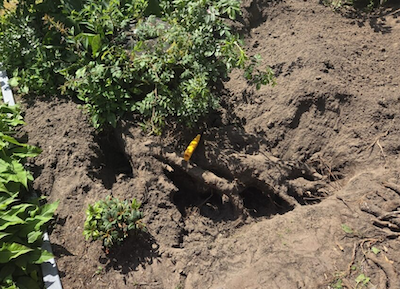
Wrestling up all the roots took about five hours of sawing and digging by hand:
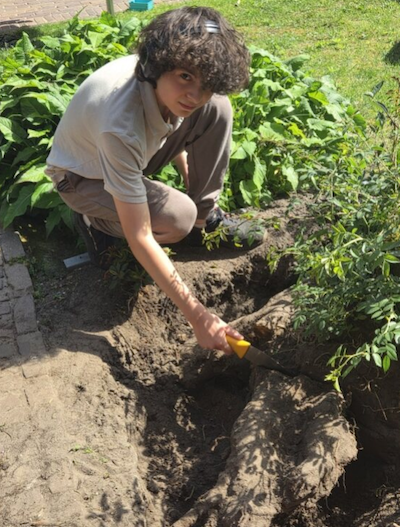
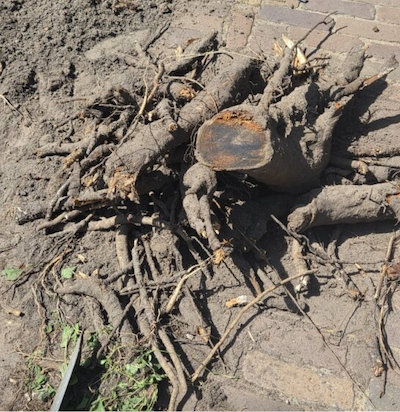
The experience is actually quite similar to writing a novel, which often seems more like unburying a story, rather than creating one. At least that's how writing feels to me. And, also, Stephen King. Here's how he describes the story-writing process in his memoir, On Writing:
"When, during the course of an interview for The New Yorker, I told the interviewer (Mark Singer) that I believed stories are found things, like fossils in the ground, he said that he didn’t believe me. I replied that that was fine, as long as he believed that I believe it. And I do. Stories aren’t souvenir teeshirts or GameBoys. Stories are relics, part of an undiscovered pre-existing world. The writer’s job is to use the tools in his or her toolbox to get as much of each one out of the ground intact as possible. Sometimes the fossil you uncover is small; a seashell. Sometimes it’s enormous, a Tyrannosaurus Rex with all those gigantic ribs and grinning teeth. Either way, short story or thousand-page whopper of a novel, the techniques of excavation remain basically the same.
"No matter how good you are, no matter how much experience you have, it’s probably impossible to get the entire fossil out of the ground without a few breaks and losses. To get even most of it, the shovel must give way to more delicate tools: airhose, palm-pick, perhaps even a toothbrush. Plot is a far bigger tool, the writer’s jackhammer. You can liberate a fossil from hard ground with a jackhammer, no argument there, but you know as well as I do that the jackhammer is going to break almost as much stuff as it liberates. It’s clumsy, mechanical, anticreative. Plot is, I think, the good writer’s last resort and the dullard’s first choice. The story which results from it is apt to feel artificial and labored."
My forthcoming novel, COVID Disobedience, is a good example of where I initially thought I was only excavating a seashell of a short story. While it's no "Tyrannosaurus Rex with all those gigantic ribs and grinning teeth," it has turned out to be three times bigger than I ever expected. (You can check out this video for a detailed update on the status of its excavation — filmed in front of Castle Helmond here in the Netherlands.)
John C.A. Manley
P.S. For more from Stephen King on the art of writing, you can purchase his inspiring and instructive memoir, On Writing. I've read it twice!
P.P.S. And, before you write me telling me King's a communist (more or less)... check out this fun short video from a discussion I had with painter Jordan Henderson about Soviet art (and what freedom-lovers can learn from it): Stephen King & Soviet Propaganda
 John C. A. Manley is the author of Much Ado About Corona, All The Humans Are Sleeping and other works of philosophical fiction that are "so completely engaging that you find yourself alternately laughing, gasping, hanging on for dear life." Get free samples of his stories by becoming a Blazing Pine Cone email subscriber.
