
Why I Couldn't Finish Reading This
Promtheus Award Finalist for Best Novel of 2026
Blazing Reader,
This is going to be a short review, as after the first fifty pages of this novel I decided to add it to a growing DNF (Did Not Finish) pile:
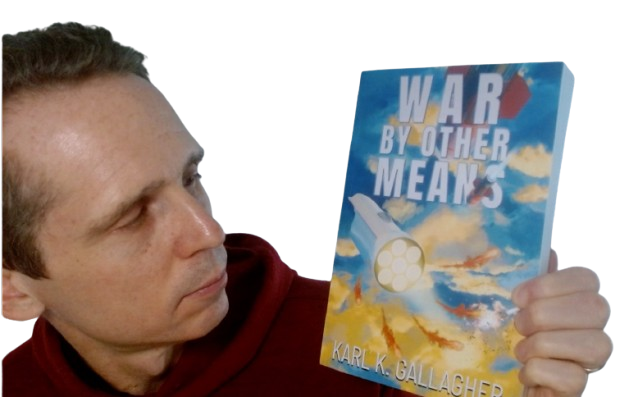
Unless I'm quite confident I'll like a book, or know the author well, I'll usually read the online preview available on Amazon before buying. With War by Other Means, however, I skipped the due diligence because it was one of the finalists for the 2026 Prometheus Award for best scifi/fantasy novel with a pro-freedom theme.
Written by Karl K. Gallaghar, this is the seventh novel in his Fall of the Censor series. Possibly, my disinterest in the story may stem from not having read the first six installments.
And, to be clear, disinterest would best describe my reaction to the story. I didn't particularly dislike it. If I didn't have so many other books I'm so eager to read, I could have endured. Possibly the rest of the book may have appealed to me more.
However, the story is a space opera, set on a far-flung world, in a far-flung time, which, I must admit, is not the type of science fiction I gravitate towards. I prefer tales set on Earth. Which may explain why I much rather had been reading two other Prometheus nominations (which, like my novel, All the Humans Are Sleeping, were not included among this year's finalists) — namely, Ray Naylor's Where the Axe is Buried and Ewan Morrison's For Emma (whose opening sample chapters had me completely enthralled).
Why our three novels are not among the finalists shows that I have different reading tastes from the Prometheus Award judges, who obviously felt War by Other Means was an excellent read. Fair enough.
War by Other Means opens up with dozens of worlds having been liberated from the oppression of the Censorates. I honestly can't remember what or who the Censorates are — which is either a reflection of my not having read the earlier novels or the inability of the story to win my attention — but, based on the name, Censorates sound like some kind of intergalactic cancel culture.
Anyway, these newly liberated worlds have a problem: The only thing they agree on is hating Censorates, otherwise, they are on the brink of war. The story opens with an ambassador, Wynny Landry, landing on one of those liberated worlds on a mission to bring peace among the natives.
I must also acknowledge that I have never been a fan of diplomatic stories. Nothing against peaceful alliances, but it's a subgenre that's never hooked me. I also didn't feel any connection with the protagonist in the first fifty pages of the story. Was she a flat 2D character? I don't know. Probably, I just don't like spending time with ambassadors.
The writing in War by Other Means is well done, but I did have an issue with the storytelling. Far too many scenes are summed up quickly — accounting for what happened, rather than recounting. Here's an example:
The guards at the front desk allowed everyone through. A second guard post needed a lecture from Major Laoly to unlock the door. The guard outside the archives themselves insisted on making some phone call to confirm that Ambassador Landry was not allowed to see the data but also to bring two 'uncleared' people in with her.
It often felt like I was reading a plot outline, rather than a story narrative. It was actually making me feel mildly ill, depressed and wondering what happened to Emma in Ewan Morrison's novel (which I really want to read next).
Fortunately, I can get back to For Emma and Where the Axe is Buried soon, as I'm almost done reading the other four finalists (cover to cover).
Needless to say, I'll be ranking War by Other Means last on the ballot for this year's Prometheus Awards.
In its defence, I suspect I'm simply not the target audience. I hate giving negative reviews, because, as an author myself, I know how much time, heart and soul go into writing a novel. Gallagher obviously has an army of devoted readers with his epic space opera, and I wish him and War by Other Means the best in this year's Prometheus Awards.
John C.A. Manley
P.S. To find out more about War by Other Means, check out the Goodreads page, where it's averaging four stars (shows what I know).
P.P.S. And for a positive review by one of the Prometheus Award judges check out: Karl K. Gallagher’s War by Other Means explores tensions between fighting to preserve freedom and giving up freedom to fight more effectively
 John C. A. Manley is the author of Much Ado About Corona, All The Humans Are Sleeping and other works of philosophical fiction that are "so completely engaging that you find yourself alternately laughing, gasping, hanging on for dear life." Get free samples of his stories by becoming a Blazing Pine Cone email subscriber.
