
"The Cutest Dog in the Universe"
Has Passed Away
Blazing Reader,
This photo is of our cocker spaniel, Harley, and me, back in January, during a rare week of snow here in the Netherlands:
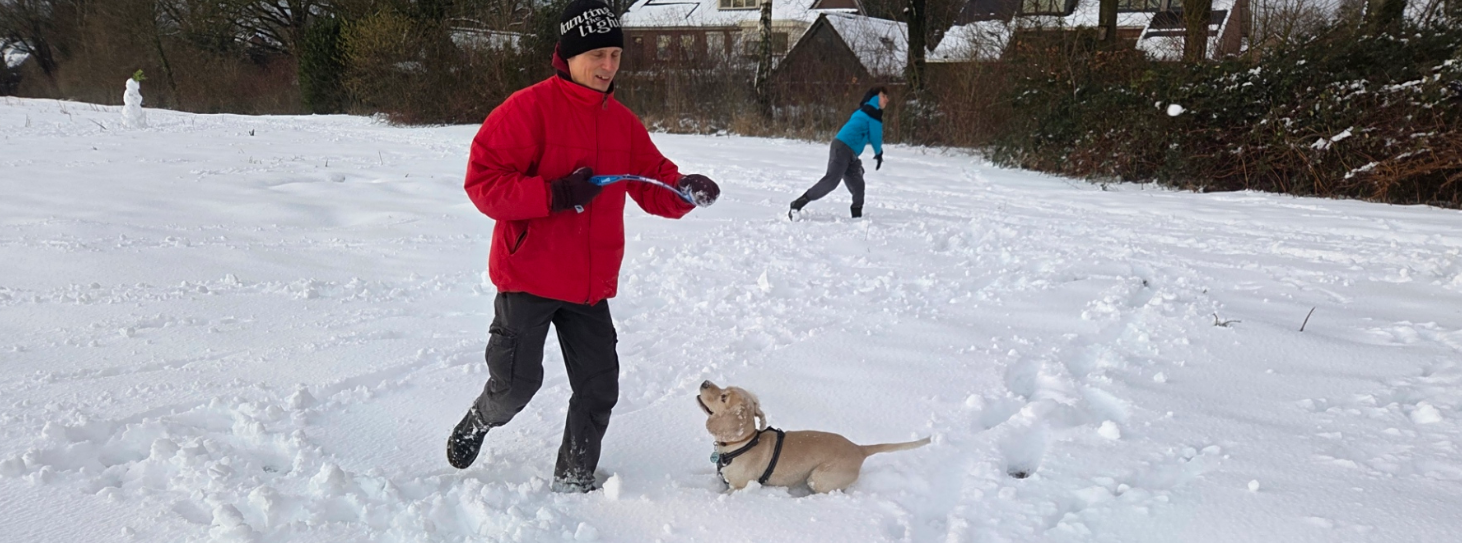
My wife, Ina, calls him the "cutest dog in the universe."
It wasn't long after that photo that Harley started to limp. We thought it was either an injury or arthritis. We tried changing his diet, carrying him on stairs and giving him joint supplements. He'd have a day or two of seeming improvement, but his condition, overall, continued to worsen.
Last week, we found he could barely walk down the street. So, on Tuesday, Ina brought him to the vet. The doctor did an ultrasound of his shoulder and found he had advanced bone cancer. Despite his otherwise happy demeanour, the vet insisted he must be in extreme pain and should be put down immediately, before the bone fractures or cancer progresses.
So, yesterday, after gorging on his favourite (and usually forbidden) food (salami pizza), and a last walk in the neighbouring field, Ina brought him to the vet, where he played with her sons until the sedative took effect.
Death creeps into all the novels I write, just as it creeps into all our lives — unwanted but inevitable.
Harley's death brought up many memories of my wife's death and reminded me of these consoling words by Rupert Spira, speaking to another man who lost his wife:
"While she was alive, you felt her partly as a physical body, on the other side of the bed, and partly in your heart, as the love you shared. It was fifty percent her body, on the other side of the bed, and fifty percent in your heart. Now she is one hundred percent in your heart. She's come closer."
Still, the outward loss is painful. As James McCrae says in his poem "Instructions Before Visiting Earth":
On this planet, nothing is permanent.
People and things will come and go.
You will fall in love and form sentimental attachments
only to lose everything you hold dear.So cling to nothing too tightly, even yourself,
and when it’s time to let go, let go with grace,
for nothing is owned, only borrowed.
Harley certainly left with grace, tail-wagging until the end.
Unless waking from a nap, happy was his default mode of existence — especially when serving as a canine vacuum cleaner of any food that dropped in the kitchen (except lettuce). He also possessed phenomenal bladder control, as he could continue to mark territory for prolonged periods through highly disciplined regulation of his urine output.
His loyalty to Ina bordered on the extreme. "It didn't matter where I was going," she wrote in a farewell letter, "upstairs, outside, to the washroom for two minutes — you always needed to know what I was doing."
And whenever she went out without him, he'd wait at the bay windows, patiently, for hours. "I miss seeing your face in the front window every time I turn the corner with my car, driving back home. The way you were scanning the street and completely lit up when you recognized me, or at least our car."
Now, no more is he waiting for us to wake up in the morning, whereupon he would immediately jump into bed, ready to be cuddled, walked and fed.
He really was, as Ina often proclaimed, the cutest dog in the universe.
John C.A. Manley
P.S. For more about my experience with my first wife's death and afterlife, check out: 3 Surreal Signs From My Wife in Heaven and An Owl From Heaven.
 John C. A. Manley is the author of Much Ado About Corona, All The Humans Are Sleeping and other works of philosophical fiction that are "so completely engaging that you find yourself alternately laughing, gasping, hanging on for dear life." Get free samples of his stories by becoming a Blazing Pine Cone email subscriber.
